Search This Blog

May 28, 2015

Paola mostra os resultados do seu mestrado com Dasyphyllum (Asteraceae)/ Paola presents her Master in Science results with Dasyphyllum (Asteraceae)

Paola Lima Ferreira, mestranda do nosso Laboratório, apresentou a sua dissertação de mestrado, cujo tema foi uma análise filogenética do gênero Dasyphyllum (Asteraceae, a família das margaridas e dos girassóis) com o uso de dados moleculares e uma discussão sobre a distribuição de caracteres críticos no gênero e usa delimitação.  O estudo foi orientado por mim (Milton) e co-orientado pela Profa. Dra. Mariana Saavedra, especialista em Asteraceae. Paola foi aluna do Programa de Pós-Graduação em Biologia Comparada, do nosso Departamento e o estudo foi financiado pela CAPES (bolsa) e Fapesp (auxílio em coletas e compra de reagentes)

A banca de mestrado foi composta pelas Profs. Drs. Benoît Loeuille (agora na Universidade Federal de Pernambuco) e André Olmos Simões (Unicamp) e por mim 

Lembrando que Paola já tinha recebido uma menção honrosa pelo seu trabalho no VI Encontro de Biologia Comparada (ver post http://sistematicadeplantasrpherbariospfr.blogspot.com.br/2013/12/aluna-do-laboratorio-ganha-mencao.html)

Parabéns Paola! Continue seu excelente trabalho!

------------------------------------

Paola Lima Ferreira, master's student in our laboratory, presented her dissertation, whose theme was a phylogenetic analysis of Dasyphyllum (Asteraceae, the family of daisies and sunflowers) using molecular data, as well as a discussion of the distribution of critic characters in the genus and also its real circuscription. The study was guided by me (Milton) and co-directed by Prof. Dr. Mariana Saavedra, an expert in Asteraceae. Paola conducted her work while a student of the Graduate Program in Comparative Biology of our Department. The study was funded by CAPES (grant) and FAPESP 

Paola´s Master in science committee was composed by Profs. Drs. Benoît Loeuille (now a  professor  in the Federal University of Pernambuco) and André Simões Olmos (Unicamp), besides me. 

And Remembering Paola had already received an honorable mention for her work in the VI Meeting of Comparative Biology (see  http://sistematicadeplantasrpherbariospfr.blogspot.com.br/2013/12/aluna-do-laboratorio-ganha-mencao.html)


Congratulations Paola! Keep your fantastic work!


A festa. Paola, "A Iluminada"/The party, Paola "The Shining"
Here is Johnny!


A banca (da esquerda para direita): André Simões, Benoît Loeuille, Paola e Milton Groppo, no Departamento de Biologia da FFCLRP-USP, Ribeirão Preto/ Paola´s Master in Science committee (from left to right): André Simões, Benoît Loeuille, Paola and Milton Groppo, at Department of Biology, FFCLRP-USP, Ribeirão Preto


May 24, 2015

Carla Bruniera defende o seu doutorado/Carla Bruniera presents her Thesis


Carla Bruniera, do nosso Laboratório de Sistemática de Plantas, apresentou a sua Tese, um estudo sistemático sobre o gênero Rudgea (Rubiaceae) realizado com dados moleculares e também uma sinopse do gênero para o Brasil. O estudo foi orientado por mim (Milton) e co-orientado pela Dra. Daniela Zappi (especialista em Rubiaceae) , do Royal Botanical Gardens, Kew (Reino Unido). Carla passou um período no Missouri Botanical Garden (Missouri- Saint Louis - Estados Unidos), onde uma parceria com a Dra. Charlotte Taylor (outra especialista em Rubiaceae) foi estabelecida. Os resultados do doutorado  já começaram a dar frutos em forma de trabalhos publicados, como a descrição de duas espécies novas de Rudgea para a Bahia (ver o post http://sistematicadeplantasrpherbariospfr.blogspot.com.br/2015/03/duas-novas-especies-de-rudgea-rubiaceae.html).


A banca de doutorado da Carla foi composta, além de mim, pelos Profs Drs. José Rubens Pirani (Instituto de Biociências, USP), Jefferson Prado (Instituto de Botânica d São Paulo), André Olmos Simões (Unicamp) e Maria Fernanda Calió (agora também da Unicamp). O estudo teve financiamento do CNPq, Capes e  Fapesp na forma de bolsas e auxílio á pesquisa e um auxílio junto ao  "Elizabeth E. Bascom Fellowships for Latin American Women in Science" para uma estada no Missouri Botanical Garden. 


Muitas felicidades, Carla!

ps: estou um pouco atrasado com os posts...

---------------------------

Carla Bruniera, from our Laboratory of Plant Systematics,  presented her thesis, a systematic study of the genus  Rudgea (Rubiaceae), which was performed using molecular data, as well as a synopsis of the genus for Brazil. The study was guided by me (Milton) and co-advisor Dr. Daniela Zappi (an expert in Rubiaceae) from the Royal Botanical Gardens, Kew (UK). Carla spent a period at the Missouri Botanical Garden (Missouri-Saint Louis - United States), where a partnership with Dr. Charlotte Taylor (another Rubiaceae expert) was established. A part of the results of Carla´s PhD has been already published , such as the description of two new species of Rudgea from Bahia (see post http://sistematicadeplantasrpherbariospfr.blogspot.com.br/2015/03/duas-novas-especies-de-rudgea-rubiaceae.html).

The PhD committee was composed, besides me, by Professors Drs. José Rubens Pirani (Biosciences Institute, USP), Jefferson Prado (Botany Institute of São Paulo), André Simões Olmos (Unicamp) and Maria Fernanda Calió (now also from Unicamp). The study was funded by CNPq, Capes and FAPESP, and by the "Elizabeth E. Bascom Fellowships for Latin American Women in Science" grant for a stay at the Missouri Botanical Garden.

Congratulations on your achievement, Carla!


ps: this news is a bit old, I'm late with the texts.


A festa depois, no Edifício "Sobre as Ondas". Hora de comemorar!/  The after party, "Sobre as Ondas Building" - time to celebrate!


A banca (da esquerda para direita): André Simôes, Fernanda Calió. José Rubens Pirani, Jefferson Prado, a agora doutora Carla e Milton Groppo, no Instituto de Biociências da USP. Aquela foto bonita de flores rosas do lado direito é Hortia oreadica Groppo, Kallunki & Pirani (um pouco de alto-propaganda...)/ Carla´s PhD committee(from left to right): André Simões, Fernanda Calió. José Rubens Pirani, Jefferson Prado, Dr. Carla and Milton Groppo, at the Biosciences Institute, USP. That lovely photo of pink flowers far right is Hortia oreadica Groppo, Kallunki & Pirani (some self-publicity ...) 


March 31, 2015

Duas novas espécies de Rudgea (Rubiaceae) são publicadas/Two new species of Rudgea (Rubiaceae) are published

Duas novas espécies do gênero Rudgea, da família Rubiaceae (a família do café) acabam de ser publicadas. Rudgea agrestophila Zappi, J.G.Jardim & Bruniera e R. hileiabaiana Zappi & Bruniera são até o momento conhecidas apenas para o estado da Bahia, Brasil. O artigo foi publicado na revista Phytotaxa.
O trabalho é fruto da colaboração da doutoranda Carla P. Bruneira e da  pesquisadora do Royal Botanic Gardens Kew,  Dra. Daniela Zappi,  sendo parte de um grande estudo sistemático da Carla focado no gênero neotropical Rudgea e de seus parentes da tribo Palicoureeae.

Um preview do artigo está disponível no Research em:


Cópias do artigo completo em pdf podem ser solicitadas aos autores via Researchgate.

-----------------------------------------------------------------------------------------------------


Two new species of Rudgea , a genus belonging to  family Rubiaceae (the coffee family) just have been published. Rudgea agrestophila Zappi, J.G.Jardim & Bruniera and R. hileiabaiana Zappi & Bruniera are known only to the state of Bahia, Brazil. The article was published in the journal Phytotaxa .
The work is a collaborative effort of the PhD student Carla P. Bruneira and Dr. Daniela Zappi, (The Royal Botanical Gardens Kew, United Kingdom). The article is a part of a large systematic study of Carla focused on the Neotropical genus Rudgea and its relatives of the tribe Palicoureeae.


A preview of the article is available at Research:


Full article copies may be requested to the authors via Researchgate


Rudgea agresteophila and R. hileiabaiana. (source: Phytotaxa)


Rudgea agresteophila and R. hileiabaiana. Ilustrations by Maíra Massarani (source: Phytotaxa)


March 22, 2015

Catálogo polínico é lançado e disponível gratuitamente/Pollen Catalog is released and available for free


Cover


O Catálogo Polínico das plantas usadas por abelhas no campus da USP de Ribeirão Preto (Editora Holos) foi lançado no final do ano de 2014. Coordenado pela pesquisadora Claúdia Inês da Silva (hoje na Universidade Federal do Ceará) e co-autorado por docentes e alunos de pós-graduação e graduação, o catálogo é um compêndio das características morfológicas de 95 plantas com flores que provém recursos polínicos para abelhas. O pólen destas plantas é ilustrado e descrito em detalhe. Além disso, o catálogo conta com textos sobre a importância da palinologia e da conservação das abelhas; como obter os grãos de pólen para análise; e como montar uma palinoteca. O Laboratório de Sistemática de Plantas deu o suporte de identificação das plantas, com o meu trabalho e principalmente com o aluno de Iniciação Científica João Paulo de Castro (bolsista CNPq). O material-testemunha vegetal foi depositado no Herbário SPFR.

O Catálogo é importante não só para o público acadêmico, mas para todos aqueles interessados em conservação da biodiversidade, para agricultores e para os produtores de mel. 

O Catálogo está disponível gratuitamente em pdf no Research Gate: https://www.researchgate.net/profile/Milton_Groppo

A versão em papel pode ser solicitada ao Prof. Carlos Garófalo (garofalo@ffclrp.usp.br), também de forma gratuita. 

-------------------------------------------------------------------------------
The Pollen Catalog of plants used by bees on the campus of Ribeirão Preto, University of São Paulo (Holos Publisher) was launched at the end of 2014. This work was coordinated by researcher Claudia Ines da Silva (Federal University of Ceará, Brazil) and co-authored by professors and graduate and undergraduate students, the book is a compendium of the morphological characteristics of 95 flowering plants which provide pollen sources for bees. Pollen characteristics are illustrated and described in detail. In addition, the catalog includes texts about the importance of palynology and conservation of bees; how to get the pollen grains for analysis and how to set up a scientific pollen collection. The Laboratory of Plant Systematics supplied the plant identification support, with my work and especially with the training student João Paulo de Castro (granted by CNPq). Vouchers from plant material were deposited at SPFR Herbarium.
(texts in Portuguese, but easily understandable)

The Catalog is important not only for academic public, but for all those interested in conservation of biodiversity, farmers and honey producers.

The catalog is available in PDF at Research Gate, and can be freely downloaded : https://www.researchgate.net/profile/Milton_Groppo

Hard copies can be requested to Prof. Carlos Garofalo (garofalo@ffclrp.usp.br), also for free.
Ceiba speciosa (paineira, silk floss tree or kapok) one of the pages of the Catalog


November 6, 2014

Anelize Barboza apresenta dados de anatomia foliar em ensaio de mudanças climáticas/Anelize Barboza presents data on leaf anatomy in a future of climate change


A aluna de mestrado do nosso laboratório Anelize Barboza apresentou a sua dissertação, cujo tema era avaliar as mudanças na anatomia foliar de duas espécies de plantas forrageiras, Stylosanthes capitata (uma leguminosa) e Panicum maximum (uma gramínea). Estas duas espécies são importantes economicamente aqui no Brasil por serem utilizadas largamente em pastos para bovinos. As plantas foram cultivadas em ambiente natural, com grupos controle e com uma mescla de tratamentos com concentração de CO2 elevado e temperatura 2oC aumentada em relação à temperatura atual, em sistemas MiniFace. O objetivo foi estudar as mudanças na anatomia foliar das plantas em condições atmosféricas simuladas futura, com efeito estufa aumentado. Os resultados mostraram que as espécies sofrem alterações em sua anatomia, que podem estar relacionadas a mudanças fisiológicas nas plantas. O estudo foi orientado pelo Prof. Milton Groppo (Departamento de Biologia) e pela Profa. Simone de Pádua Teixeira (Faculdade de Ciências Farmacêuticas de Ribeirão Preto, USP), sendo parte de um projeto temático realizado com verba Fapesp e coordenado pelo professor Carlos Martinez y Huaman, também do nosso Departamento.

Parabéns pela conquista Anelize!

----------------------------------------------------

Anelize Barboza presents data on leaf anatomy in a future of climate change


Anelize Barboza, a graduate student of our lab  presented his dissertation a couple of weeks ago, whose topic was to evaluate the changes in the leaf anatomy of two species of forage plants, Stylosanthes capitata (a legume) and Panicum maximum (a grass). These two species are economically important in Brazil because they are widely cultivated in pastures for cattle. Plants were grown in a natural environment, with control groups and with a mix of treatments with elevated CO2 concentration, together with  a temperature increased 2oC in relation to the current temperature, in a MiniFace system. The aim was to study the changes in leaf anatomy of plants in simulated future atmospheric conditions, with increased greenhouse. The results showed that the species undergo changes in their anatomy, which may be related to physiological changes. The study was supervised by Professor Milton Groppo (Department of Biology) and Professor Simone de Padua Teixeira (Faculty of Pharmaceutical Sciences of Ribeirão Preto, USP). It is a part of a larger thematic project carried out with funds from FAPESP and coordinated by Professor Carlos Martinez y Huaman, also of our Department.

Congratulations on winning Anelize!

Anelize presenting her dissertation. Top left: dissertation committee: from left to right, Milton Groppo, Anelize, Cristiana Ribeiro Marinho and Bárbara Baêsso Moura. Photos by A. Barboza.


September 26, 2014

Carla Bruniera vai a Europa/Carla Bruniera going Europe

A aluna de doutorado do nosso laboratório Carla P. Bruniera passou recentemente uma mês na Europa visitando herbários importantes para o seu projeto "Sistemática de Rudgea (Rubiaceae)". Carla ficou baseada em Kew, Inglaterra, mas pôde ir à Paris (Herbário P), Bruxelas (BR), Munique (M) e Genebra (G). A viagem foi importante para o exame de material-tipo e coleções históricas de várias espécies de Rudgea e de gêneros próximos. Sem contar a oportunidade de conversar com amigos e conhecer um pouco das cidades.
Carla está vinculada no Programa de Pós-Graduação em Botânica, Instituto de Biociências, Universidade de São Paulo e deve defender o seu doutorado no próximo ano. 

Ótima viagem, Carla! 
---------------------------------------------------------------------------------
Carla P. Bruniera,  a PhD student from our laboratory  spent one month in Europe visiting important herbaria for your project "Systematics of Rudgea (Rubiaceae)" . Carla was based in Kew, England, but she could go to Paris (P Herbarium), Brussels (BR), Munich (M) and Geneva (G). The trip was important to examine types and historical collections of several species of Rudgea and other related genera. Not to mention the opportunity to chat with friends and meet some aspects of the cities.
Carla is linked to the Graduate Program in Botany, Institute of Biosciences, University of São Paulo, Brazil. She plains on finishing her doctorate next year.


Great trip, Carla!

Carla at Kew Herbarium, England

 Kew Herbarium, a boring place to work, uh?


Kew Herbarium, outside the building

April 4, 2014

II Darwin Day - Ribeirão Preto, Brazil

Sim, nós temos um Darwin Day!

O "Darwin Day RP" (RP - Ribeirão Preto, Brasil), é um evento organizado pelos alunos de pós-graduação do Departamento de Biologia (FFCLRP) da Universidade de São Paulo, Ribeirão Preto, Brasil. Dois Programas de Pós-Graduação estão envolvidos: o de Biologia Comparada o de Entomologia. O evento tem como objetivo discutir as idéias de Charles Darwin, assim como o seu legado no campo da Biologia. Há também uma página do facebook: https://www.facebook.com/darwindayrp. 

Todos estão convidados!

Mais informações em:
http://darwinday.org/events/ii-darwin-day-rp-4/
--------------------------------------------------------------

Yes, we have a Darwin Day!

The "Darwin Day RP" (RP - Ribeirão Preto, Brazil), is an event organized by the postgraduate students from the Department of Biology (FFCLRP),  University of São Paulo, Brazil. Two postgraduate programs from that Department are  the organizers: Comparative Biology and Entomology. The event aims discussing Charles Darwin´s ideas, as well as his legacy in the field of  Biology. 
There´s also a facebook page: https://www.facebook.com/darwindayrp.
All are invited!

Further information at:
http://darwinday.org/events/ii-darwin-day-rp-4/

Date/Time

Thu, April 10, 2014 
9:00 AM

Location
University of São Paulo, FFCLRP
Av. Bandeirantes, 3900.
Ribeirão Preto, São Paul
o


DARWIN DAY RIBEIRÃO PRETO


PROGRAM


December 8, 2013

Parque Chiribiquete- Colômbia/ Chiribiquete Park - Colombia


Pense em um paraíso para os estudiosos da biodiversidade:

agora vejam esta linda reportagem feita com três dos exploradores que percorreram a floresta e os tepuis e reconstruíram a aventura de descobrir um dos lugares mais inexplorados do planeta, hoje o Parque Chiribiquete, na Colômbia. Uma maravilha no meio da Amazônia.
A reportagem está em espanhol.
-------------------------------------------------
Think about a haven for any researcher in biodiversity :

now check this beatiful report of three explorers who roamed the forest and the tepuis to discover one of the wildest places on the planet, today the Chiribiquete Park, in Colombia. A marvel in the middle of Amazonia.
Report is in Spanish.


Parque Chiribiquete- Colômbia/ Chiribiquete Park - Colombia


Aluna do Laboratório ganha menção honrosa/ Student earns honorable mention

Este ano ocorreu a 6a edição do Encontro em Biologia Comparada, organizado pelos alunos de pós-graduação do Programa em Biologia Comparada, vinculado ao Departamento de Biologia da nossa Faculdade. Este encontro, realizado desde 2008,trás várias atividades, como palestras, mesas redondas, uma seção de painéis e mini-cursos. Acesse a página do encontro em http://sites.ffclrp.usp.br/ebc/

This year the 6th edition of the Comparative Biology Meeting was held, organized by the graduate students of our Pos-graduation Program in Comparative Biology, Department of Biology of our Faculty. This meeting, held since 2008, encompasses several academic activities, such as lectures, roundtable conferences, a section of posters as well as short-term courses. Visit the Meeting page at http://sites.ffclrp.usp.br/ebc/


6th Comparative Biology Meeting http://sites.ffclrp.usp.br/ebc/index.html


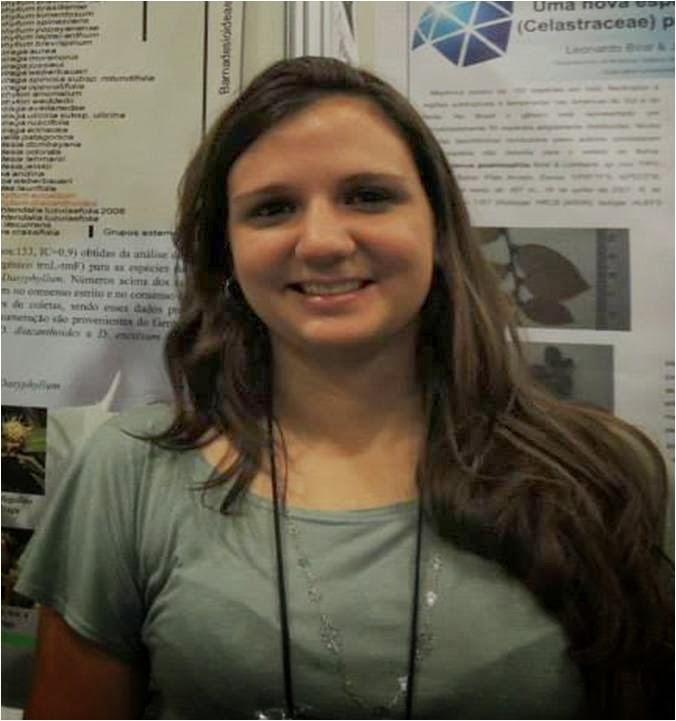
Como uma das funções deste blog é mostrar o que fazermos no nosso Laboratório, é bom contar que a  aluna de pós-graduação em Biologia Comparada Paola  de Lima Ferreira recebeu menção honrosa pelo seu painel durante o encontro deste ano. O painel da aluna Paola mostrou os primeiros resultados de um estudo filogenético do gênero neotropical Dasyphyllum, da família Asteraceae (a família das margaridas e dos girassóis) utilizando dados moleculares. O estudo conta com a colaboraçao da Dra. Mariana Saavedra, da Universidade Federal do Rio de Janeiro.
Parabéns pela conquista, Paola!

As one of the functions of this blog is to show what we do in our lab, it is a pleasure to inform that our graduate student in Comparative Biology Paola de Lima Ferreira has received an honorable mention for her poster in this year's Meeting. Paola´s poster showed the first results of a phylogenetic analysis of the Neotropical genus Dasyphyllum (family Asteraceae, the same of of daisies and sunflowers) using molecular data. This study  counts with the collaboration of Dr. Mariana Saavedra, from Federal University of Rio de Janeiro, Brazil.

Congratulations on your achievement, Paola!


Paola 

Paola´s poster


November 20, 2013

Amborella revisitado/Amborella revisited


O posicionamento do gênero Amborella (endêmico da Nova Caledônia) como grupo-irmão de todas as outras angiospermas tem sido questionado em alguns trabalhos, que apontariam a sua relação mais próxima às Nymphaeales (ninféias e parentes) e aí sim, este clado seria irmão à todas as outras angiospermas. Ou ainda que as Nymphaeales poderiam ser o grupo-irmão das outras angiospermas (ver topologias alternativas abaixo):
----------------------------------------------------------------------------------
The placement of the genus Amborella (endemic to New Caledonia) as the sister group of all other angiosperms has been questioned in some studies, which would point to its closest relationship to Nymphaeales (water lilies and relatives) and then this clade would be sister to  all other angiosperms. Or, alternatively, Nymphaeales themselves could be the sister group to  all other angiosperms (see alternative topologies below):


http://blog.opentreeoflife.org/2013/11/19/which-came-first-the-soltis-lab-probes-lineage-of-angiosperms/


Um novo estudo realizado no Laboratório de Douglas Soltis (Universidade da Flórida) pelo pós-doutorando Bryan Drew, utilizando dados do genoma plastidial (236 táxons, 78 regiões e ~58.000 pares de base) lança novos dados sobre o problema  e tenta resolver a questão que ainda persiste: qual linhagem de angiospermas atuais divergiu primeiro?
 -----------------------------------------------------------------------------------
A new study in Douglas Soltis´ Lab. (University of Florida) made by postdoc Bryan Drew using molecular data (plastid plastidial genome, 236 taxa, 78 regions and ~ 58,000 base pairs) shed light to the problem, trying to answer to the longstanding question: which lineage of extant angiosperms  did diverge first?(see in http://blog.opentreeoflife.org/2013/11/19/which-came-first-the-soltis-lab-probes-lineage-of-angiosperms/)


November 19, 2013

Exposição Martius & Spix/ Martius & Spix Exhibition


No próximo dia 21 de novembro de 2013 (quinta-feira, às 19:00 horas) haverá a exposição "Múltiplos Sentidos de Martius & Spix", a ser realizada no Auditório da Faculdade de Direito de Ribeirão Preto, Universidade de São Paulo, Ribeirão Preto, Brasil. A apresentação será um evento conjunto realizado entre o Departamento de Música e o de Biologia da nossa Faculdade. 
Martius e Spix participaram da expedição bávara-austríaca que percorreu o Brasil no século XIX coletando plantas, animais e informações sobre o os povos locais, suas músicas e seus costumes. Para os botânicos, esta expedição foi importante pois forneceu o grosso do material para a confecção da grandiosa Flora brasiliensis, o maior tratamento de uma flora em todos os tempos.

Durante o evento haverá palestras sobre a expedição de Martius & Spix e apresentação de músicas recolhidas por Martius durante a expedição e uma exposição de plantas (exsicatas do nosso Herbário, SPFR) e animais. Além disso, haverá a exposição de quatro volumes originais da Flora brasiliensis, gentilmente emprestados pela biblioteca do Instituto de Biociências da USP,  um tesouro que vale a pena ser visto.

A programação segue abaixo, uma viagem na história, música e no estudo da biodiversidade do nosso país.

A entrada é franca! Apareçam!
----------------------------------------------------------------------
Next November the 21th, 2013 ( Thursday , 19:00 pm) there will be the exhibition " "Múltiplos Sentidos de Martius & Spix" (Multiple Perceptions of Spix & Martius ) , to be held in Faculty of Law of Ribeirão Preto Auditorium , University of São Paulo , Ribeirão Preto, Brazil . The exbibition will be a joint event held between the Department of Music and the Biology of our Faculty .
Martius and  Spix were two german naturalists who attended the Bavarian -Austrian expedition that toured Brazil in the nineteenth century collecting plants , animals and different information about the local people, their music and their customs . For botanists, this expedition was important because it provided the bulk of the material for making the colossal Flora brasiliensis , the greatest treatment of a flora of all times .

During the event there will be lectures about the expedition of Spix & Martius and presentation of songs collected by Martius during his stay in Brazil, besides exhibition of plants (dry plants in exsicatae, from our herbarium SPFR) and animals . In addition, four original volumes of Flora brasiliensis (kindly loaned by the Institute of Biosciences of USP Library) will be exposed,  a treasure that is worth to be seen .

The program follows a journey into the history, music and the study of biodiversity of our country .

Admission is free ! Turn It Up!


October 31, 2013

Que planta é esta? #5 a resposta/What is this plant? #5 the answer

Agora vão as fotos completas e as espécies das quatro plantas do nosso último desafio. Todas as plantas eram de áreas de Cerrado e Mata Estacial Semidecidual do interior do estado de São Paulo, Brasil:
Ninguém acertou o desafio inteiro, mas Rubens Queiroz chegou mais perto: todos os gêneros corretos e duas espécies corretas. Parabéns de novo Rubens, você é uma máquina de identificações!

Vejam as fotos completas abaixo:
-----------------------------------------------------------------------------------

Now here they go: full pictures and the species of the four plants of our last challenge. All of them were from the Cerrado (Brazilian Savannah) and Sazonal Semideciduous Forest, in the inner portion of São Paulo State, Brazil. 
Nobody hit the jackpot, but Rubens Queiroz nearly hit: all genera correct, besides two species. Congrats again, Rubens, you are an identification machine!

See full pictures below:


Desafio original:/
Original challenge:
Click here: Desafio #5/Challenge #5

Figura original/ original picture Desafio #5/Challenge #5


Agora as plantas:/
Now the plants:


A) Prockia crucis P. Browne ex L. (Salicaceae) 

Prockia crucis (Salicaceae) - Luís Antônio, São Paulo, Brazil. Floresta Estacional Semidecidual/ Seasonal Semideciduous  Forest. Photo by Milton Groppo 
B) Caryocar brasiliense Cambess. (Caryocaraceae) - o "pequi "/ "pequi"
Pequi - Caryocar brasiliense (Caryocaraceae) Luís Antônio, São Paulo, Brazil. Cerrado/Brazilian Savannah. Photo by Milton Groppo

C) Bromelia balansae Mez (Bromeliaceae) - "caraguatá"

Bromelia balansae (Bromeliaceae) Luís Antônio, São Paulo, Brazil - Cerrado/Brazilian Savannah. Photo by Milton Groppo


D) Pterogyne nitens Tul. (Leguminosae) -  "amendoim-do-campo"
Pterogyne nitens (Leguminosae) - Luís Antônio, São Paulo, Brazil. Floresta Estacional Semidecidual/ Seasonal Semideciduous  Forest. Photo by Milton Groppo 
Pterogyne nitens (Leguminosae) fruto (samara)/ fruit (samara)- Luís Antônio, São Paulo, Brazil. Floresta Estacional Semidecidual/ Seasonal Semideciduous  Forest. Photo by Milton Groppo


Para ver o desafio #1 e a proposta original (além da sua resposta) clique:/ 
To see the first challenge (and the idea behind it) and its answer, chick: 
http://sistematicadeplantasrpherbariospfr.blogspot.com.br/2013/09/que-planta-e-esta-what-is-this-plant-1.html

para desafios anteriores clique:/


October 28, 2013

Que planta é esta? - COMBO!/What is this plant? #5 COMBO!

Hoje temos 4 plantas no nosso desafio. Um verdadeiro combo!
Todas as plantas são nativas do Brasil.

ps: os comentários estão ocultos até a resposta.
----------------------------------------------------------------

Today there are four different plants in this challenge. A true combo!
All species are Brazilian ones.

ps: comments are hidden till answer.


Que planta é essa #5/ What is this plant #5


Para ver o desafio #1 e a proposta original (além da sua resposta) clique:/ 
To see the first challenge (and the idea behind it) and its answer, chick: 

http://sistematicadeplantasrpherbariospfr.blogspot.com.br/2013/09/que-planta-e-esta-what-is-this-plant-1.html

para desafios anteriores clique:/

October 24, 2013

Kew abre Herbário para visitas/ Kew Herbarium open to visitors


O Herbário de Kew Gardens (Surrey, Inglaterra) é um verdadeiro tesouro da humanidade, uma das maiores coleções de plantas do mundo e um dos centros de pesquisa mais dinâmicos em taxonomia de plantas. Recentemente o Herbário foi aberto para visitantes externos e a população pode se deliciar com os seus tesouros. Vejam em http://www.nytimes.com/2013/10/15/science/a-rare-open-house-lets-visitors-in-the-herbarium-at-kew-gardens.html?smid=fb-share&_r=0

Só o começo do artigo já aguça a vontade:

"There was a Galápagos fern, collected by Charles Darwin himself. There were mahogany cabinets filled with plants from the East India Company, including the two tea leaves whose discovery launched the Indian tea trade. There was an antelope net made of baobab bark, from David Livingstone’s storied Zambezi expedition more than 150 years ago."

Que ótima iniciativa!

Kew, eu realmente sinto saudades!
-----------------------------------------------------------------------------------------------------------
The Herbarium at Kew Gardens (Surrey, England) is a real treasure of humanity, one of the largest collections of plants in the world and one of the most dynamic research centers focused in plant taxonomy. The Herbarium was recently opened to outside visitors, and population can be delighted with their treasures. Look at  http://www.nytimes.com/2013/10/15/science/a-rare-open-house-lets-visitors-in-the-herbarium-at-kew-gardens.html?smid=fb-share&_r=0

In the very beginning of the article you can see the point:

"There was a Galápagos fern, collected by Charles Darwin himself. There were mahogany cabinets filled with plants from the East India Company, including the two tea leaves whose discovery launched the Indian tea trade. There was an antelope net made of baobab bark, from David Livingstone’s storied Zambezi expedition more than 150 years ago."

What a great initiative!

Kew, I really miss you!


The herbarium, built in 1877, is the oldest part of Kew Gardens. Tim Harris, an assistant botanist, showed ferns collected by Charles Darwin in the Galápagos Islands. Source: http://www.nytimes.com/2013/10/15/science/a-rare-open-house-lets-visitors-in-the-herbarium-at-kew-gardens.html?smid=fb-share&_r=1&