Search This Blog

November 16, 2015

Inventário completo e atualizado da flora de plantas com sementes no Brasil é lançado/ A complete, updated inventory of Brazilian seed plants is released


Direto do resumo: 

Um levantamento atualizado das plantas com sementes e análises relevantes acerca desta biodiversidade são apresentados. Este trabalho se iniciou em 2010 com a publicação do Catálogo de Plantas e Fungos e, desde então vem sendo atualizado por mais de 430 especialistas trabalhando online. O Brasil abriga atualmente 32.086 espécies nativas de Angiospermas e 23 espécies nativas de Gimnospermas e estes novos dados mostram um aumento de 3% da riqueza em relação a 2010.
A Amazônia é o Domínio Fitogeográfico com o maior número de espécies de Gimnospermas, enquanto que a Floresta Atlântica possui a maior riqueza de Angiospermas. Houve um crescimento considerável no número de espécies e nas taxas de endemismo para a maioria dos Domínios (Caatinga, Cerrado, Floresta Atlântica, Pampa e Pantanal), com exceção da Amazônia que apresentou uma diminuição de 2,5% de endemicidade. Entretanto, a maior parte das plantas com sementes que ocorrem no Brasil (57,4%) é endêmica deste território. A proporção de formas de vida varia de acordo com os diferentes Domínios: árvores são mais expressivas na Amazônia e Floresta Atlântica do que nos outros biomas, ervas são dominantes no Pampa e as lianas apresentam riqueza expressiva na Amazônia, Floresta Atlântica e Pantanal. Este trabalho não só quantifica a biodiversidade brasileira, mas também indica as lacunas de conhecimento e o desafio a ser enfrentado para a conservação desta flora

O inventário saiu na revista Rodriguésia (do Jardim Botânico do Rio de Janeiro) e está disponível  aqui  ou aqui
-----------------------------------------------------------------------
From the abstract:

An updated inventory of Brazilian seed plants is presented and offers important insights into the country’s biodiversity. This work started in 2010, with the publication of the Plants and Fungi Catalogue, and has been updated since by more than 430 specialists working online. Brazil is home to 32,086 native Angiosperms and 23 native Gymnosperms, showing an increase of 3% in its species richness in relation to 2010. The Amazon Rainforest is the richest Brazilian biome for Gymnosperms, while the Atlantic Rainforest is the richest one for Angiosperms. There was a considerable increment in the number of species and endemism rates for biomes, except for the Amazon that showed a decrease of 2.5% of recorded endemics. However, well over half of Brazillian seed plant species (57.4%) is endemic to this territory. The proportion of life-forms varies among different biomes:
trees are more expressive in the Amazon and Atlantic Rainforest biomes while herbs predominate in the Pampa, and lianas are more expressive in the Amazon, Atlantic Rainforest, and Pantanal. This compilation serves not only to quantify Brazilian biodiversity, but also to highlight areas where there information is lacking and to provide a framework for the challenge faced in conserving Brazil’s unique and diverse flora.

The inventory was published in Rodriguésia (Rio de Janeiro Botanical Garden), and is available here or here

July 5, 2015

Belíssimo livro sobre o Jardim Botânico de São Paulo agora em promoção!/A beautiful book on the São Paulo Botanical Garden on sale!


Capa/Cover


Antes de trabalhar na Universidade de São Paulo fui por um breve período pesquisador científico no Instituto de Botânica de São Paulo. Junto ao Instituto há o Jardim Botânico de São Paulo, uma área aberta à população, um oásis verde no concreto de São Paulo. Todos o anos tenho levado meus alunos da graduação para uma passeio até lá. Veja um post mais antigo, da visita de 2013 AQUI

Em 2012 um livro sobre o Jardim Botânico foi publicado, com autoria de Juan Esteves (fotos) e texto de Maria Guimarães, um querida amiga da minha graduação. São "202 páginas dedicadas aos paisagistas, botânicos, biólogos, arquitetos e aos que simplesmente gostam de conhecer lugares bonitos, como esta reserva fundada em 1928 no meio da mata atlântica paulistana" (como escrito por pela Editora). Há também uma resenha no site da Fapesp AQUI.
O livro (em português) agora está em uma promoção incrível (R$39,00) e pode ser adquirido diretamente no site da editora Terceiro Nome: 


Definitivamente um livro que gostaria de ter escrito!

--------------------------------------
Before working at the University of São Paulo I was (though for a brief period) a researcher at the São Paulo Botany Institute. Next to the Institute is the Botanical Garden of São Paulo, an open area to the population, a green oasis in the concreted São Pauo. Every year I have taken my graduate students for a ride up there. See an earlier post, the 2013 visit HERE


Well, in 2012 a book on the São Paulo Botanical Garden was published, authored by Juan Esteves (pictures) and text by Maria Guimarães, one dear friend of my graduation course. The book contains "202 pages devoted to landscapers, botanists, biologists, architects and those who just like to know beautiful places, as this Reserve founded in 1928 in the middle of the São paulo Atlantic Rainforest " (as written by the Publisher). There is also a review on the site of FAPESP HERE
The book (in Portuguese) is now an incredible deal (R$ 39.00) and can be purchased directly on the Terceiro Nome publisher's website :


Definitely a book that I would have written!


Azaléias/Rhododendron. By Juan Esteves 

Babosa sendo visitada/Aloe being visited. By Juan Esteves 

Cerejeira/Cherry-tree By Juan Esteves 

Estufas/Greenhouses. By Juan Esteves 

Lago das Ninféias/Waterlilies lake. By Juan Esteves 


July 2, 2015

Poster espetacular sobre a Vegetação da América do Sul/ Amazing poster on South America vegetation types


Quatro queridos colegas (Pedro Fiaschi, Gustavo Heiden, Alexandre Antonelli e José Rubens Pirani, meu orientador) acabam de disponibilizar um espetacular poster com fotos dos principais tipos de vegetação da América do Sul. 

Ótimo para aulas, cursos e para ser impresso e disponibilizado nos laboratórios

Disponível aqui

Parabéns aos autores!

-------------------------------------------------


Four dear colleagues (Pedro Fiaschi, Gustavo Heiden, Alexandre Antonelli, and José Rubens Pirani, my former advisor) just provide a spectacular poster with pictures of the main types of vegetation in South America.

Really great for classes, courses and to be printed and made available in laboratories

Available here

Congratulations to the authors!


June 21, 2015

Carla Bruniera publica seus dados sobre as Almeidea, Conchocarpus e outras Galipeinae (Rutaceae)/ Carla publishs her results on Almeidea, Conchocarpus and other Galipeinae (Rutaceae/

O primeiro estudo focado na maior subtribo Neotropical de Rutaceae, as Galipeinae, foi recentemente publicado na revista PLoS ONE. Fruto do estudo de mestrado da aluna (agora orgulhosamente doutora) Carla Bruniera, o estudo mostra as relações no grupo das Galipeinae e ainda resolve o posicionamento das plantas do gênero Almeidea (cinco espécies da Mata Atlântica do Brasil, com disjunção em regiões bolivianas) e do gênero polimórfico Conchocarpus, o maior  do grupo (ca. 50 espécies). Com muita dor no coração para mim, as plantas posicionadas em Almeidea (quase todas com flores róseas e chamativas, com o pólen pantoporado), tiveram de ser transferidas para Conchocarpus, que pouco  a pouco está sendo melhor delimitado. O estudo também investiga a distribuição de alguns caracteres críticos em Galipeinae. 
O trabalho teve colaboração decisiva da Dra. Jacquelyn Kallunki, do New York Botanical Garden
O estudo foi financiado pela Fapesp e CNPq e pode ser baixado (acesso aberto) 
aqui ou aqui

---------------------------------------------------------------------------

The first study focused in the largest Neotropical subtribe of Rutaceae, the Galipeinae, has just been  published in PLoS ONE Journal. One of the results of the Master in Science dissertation of Carla Bruniera (now a proudly Phd) the study shows the relationships within Galipeinae, and solves the positioning of the genus Almeidea (five species of the Atlantic Rainforest of Brazil, with a disjunctive distribution in some Bolivian regions), and also the relationship of polymorphic Conchocarpus (about 50 species). Unfortunately, and with a broken heart of myself, species positioned in Almeidea (almost all with showy, pinky flowers and pantoporate pollen grains), had to be transferred to Conchocarpus, a group which has been solved and better delimited step by step. The study also investigates the distribution of some critical characteristics in Galipeinae. 

The work had a decisive collaboration of Dr. Jacquelyn Kallunki, from The New York Botanical Garden
The study was funded by FAPESP and CNPq and can be downloaded (open access) here or here

Algumas Galipeinae e Pilocarpinae (grupo irmão das Galipeinae) utilizadas no estudo/ Some Galipeinae and Pilocarpinae sampled in the study . A. Inflorescence of Almeidea rubra. B. Flowers of Almeidea albiflora. C. Flower of Andreadoxa flava. D. Habit of Conchocarpus macrophyllus. E. Flower of Conchocarpus macrophyllus. F. Flower of Erythrochiton brasiliensis. G. Flower of Esenbeckia grandiflora H. Flower of Galipea jasminiflora. All by Milton Groppo except F (by Cláudio N. Fraga) and H (by Flávio A. Bonatti). (source: Bruniera et al. 2015).


Dois caracteres críticos em Galipeinae (Rutaceae): conação das pétalas e adnação dos estames em investigados sobre a árvore de Análise Bayesiana (dados moleculares/ History of two critical characteristics in Galipeinae: connation of petals, and adnation of the stamens the corola,  traced onto the majority-rule consensus tree from Bayesian analysis of the combined molecular data:
A. character 11, with photo of flower of Almeidea rubra (by M. Groppo), showing free petals; B. character 13, with photo of the flower of Almeidea albiflora (by M. Groppo), showing filaments free from the petals. Source: Bruniera et al. (2015)


June 12, 2015

O que os botânicos fazem em uma festa de casamento?/ What do botanists do in a wedding party?

Aproveitando o Dia dos Namorados aqui no Brasil...

Há duas semanas ocorreu o casamento de um aluno de doutorado do nosso Laboratório, Paulo Cabral, com a sua noiva (agora esposa) Ana Paula. Depois da cerimônia na Igreja ocorreu a festa na cidade em uma área de evento no Distrito de Bonfim Paulista, aqui em Ribeirão Preto.

A festa foi excelente, com muita comida, bebida, pessoas ótimas e um lugar bastante agradável. Nossa mesa contava com vários alunos do Laboratório e seus agregados: Anelize e Júlio, Carla e Mateus,  Carolina e Fernando, Paola, eu (Milton) e minha esposa Cíntia.

Lá pelas três da manhã espera-se que as pessoas normais estejam bêbadas e rindo muito em uma festa. Nós estávamos, mas com botânicos na mesa, foi impossível o arranjo de flores não ser destruído em nome da ciência. Vejam as fotos:
--------------------------------------------------
Talking about the Valentine's Day here in Brazil ...

Two weeks ago it occurred the marriage of Paulo Cabral, a PhD student of our Lab.,  with his fiancee (now wife) Ana Paula. After the ceremony in the church there was the after party in Bonfim Paulista District, here in our city, Ribeirão Preto.

The party was great, with lots of food, drink, great people, and a very nice place. Our table had some students of our Laboratory and their mates: Anelize and Julio, Carla and Mateus, Carolina and Fernando, Paola, I (Milton) and my wife Cintia. 


At about three a.m., it is expected that ordinary people partying are drunk and laughing a lot. We were, but with botanists at the table, it was impossible the flower arrangement not be destroyed in the name of science. See the pics below:
Carolina (esquerda, agora trabalhando com anatomia foliar de Rutaceae, a família da laranja) e Paola (direita, especialista em Asteraceae, a família dos girassóis), com as Gerbera (Asteraceae) e a conversa de loucos:

Paola: "Que tribo de Asteraceae é?"
Milton: "Heliantheae? - muito em dúvida" (a tribo das margaridas)
Paola "Não, é Mutisieae, veja as flores com corola bilabiada!"
Imaginem os outros convidados ouvindo esta conversa!
------------------------------

Carolina (left, now working with foliar anatomy of Rutaceae, the orange family) and Paola (right, specialist in Asteraceae, the sunflower family), with some Gerbera (Asteraceae) and the crazy talk:

Paola: "What tribe does it belong?"
Milton: "Heliantheae (the daisy tribe)? - quite doubtful"
Paola: "No, it is a Mutiseae, look to the flowers with bilabiate corolas!"
Can you image the other guests listening to this conversation?


O novo casal e os convidados (da esquerda para a direita): Júlio, Anelize, Cíntia, Milton, a noiva Paula, o noivo Paulo, Carolina, Carla, Paola e Mateus/ The new couple and their guests (from left to right): Júlio, Anelize, Cíntia, Milton, the bride Ana Paula , the groom Paulo, Carla, Paola and Mateus


May 28, 2015

Paola mostra os resultados do seu mestrado com Dasyphyllum (Asteraceae)/ Paola presents her Master in Science results with Dasyphyllum (Asteraceae)

Paola Lima Ferreira, mestranda do nosso Laboratório, apresentou a sua dissertação de mestrado, cujo tema foi uma análise filogenética do gênero Dasyphyllum (Asteraceae, a família das margaridas e dos girassóis) com o uso de dados moleculares e uma discussão sobre a distribuição de caracteres críticos no gênero e usa delimitação.  O estudo foi orientado por mim (Milton) e co-orientado pela Profa. Dra. Mariana Saavedra, especialista em Asteraceae. Paola foi aluna do Programa de Pós-Graduação em Biologia Comparada, do nosso Departamento e o estudo foi financiado pela CAPES (bolsa) e Fapesp (auxílio em coletas e compra de reagentes)

A banca de mestrado foi composta pelas Profs. Drs. Benoît Loeuille (agora na Universidade Federal de Pernambuco) e André Olmos Simões (Unicamp) e por mim 

Lembrando que Paola já tinha recebido uma menção honrosa pelo seu trabalho no VI Encontro de Biologia Comparada (ver post http://sistematicadeplantasrpherbariospfr.blogspot.com.br/2013/12/aluna-do-laboratorio-ganha-mencao.html)

Parabéns Paola! Continue seu excelente trabalho!

------------------------------------

Paola Lima Ferreira, master's student in our laboratory, presented her dissertation, whose theme was a phylogenetic analysis of Dasyphyllum (Asteraceae, the family of daisies and sunflowers) using molecular data, as well as a discussion of the distribution of critic characters in the genus and also its real circuscription. The study was guided by me (Milton) and co-directed by Prof. Dr. Mariana Saavedra, an expert in Asteraceae. Paola conducted her work while a student of the Graduate Program in Comparative Biology of our Department. The study was funded by CAPES (grant) and FAPESP 

Paola´s Master in science committee was composed by Profs. Drs. Benoît Loeuille (now a  professor  in the Federal University of Pernambuco) and André Simões Olmos (Unicamp), besides me. 

And Remembering Paola had already received an honorable mention for her work in the VI Meeting of Comparative Biology (see  http://sistematicadeplantasrpherbariospfr.blogspot.com.br/2013/12/aluna-do-laboratorio-ganha-mencao.html)


Congratulations Paola! Keep your fantastic work!


A festa. Paola, "A Iluminada"/The party, Paola "The Shining"
Here is Johnny!


A banca (da esquerda para direita): André Simões, Benoît Loeuille, Paola e Milton Groppo, no Departamento de Biologia da FFCLRP-USP, Ribeirão Preto/ Paola´s Master in Science committee (from left to right): André Simões, Benoît Loeuille, Paola and Milton Groppo, at Department of Biology, FFCLRP-USP, Ribeirão Preto


May 24, 2015

Carla Bruniera defende o seu doutorado/Carla Bruniera presents her Thesis


Carla Bruniera, do nosso Laboratório de Sistemática de Plantas, apresentou a sua Tese, um estudo sistemático sobre o gênero Rudgea (Rubiaceae) realizado com dados moleculares e também uma sinopse do gênero para o Brasil. O estudo foi orientado por mim (Milton) e co-orientado pela Dra. Daniela Zappi (especialista em Rubiaceae) , do Royal Botanical Gardens, Kew (Reino Unido). Carla passou um período no Missouri Botanical Garden (Missouri- Saint Louis - Estados Unidos), onde uma parceria com a Dra. Charlotte Taylor (outra especialista em Rubiaceae) foi estabelecida. Os resultados do doutorado  já começaram a dar frutos em forma de trabalhos publicados, como a descrição de duas espécies novas de Rudgea para a Bahia (ver o post http://sistematicadeplantasrpherbariospfr.blogspot.com.br/2015/03/duas-novas-especies-de-rudgea-rubiaceae.html).


A banca de doutorado da Carla foi composta, além de mim, pelos Profs Drs. José Rubens Pirani (Instituto de Biociências, USP), Jefferson Prado (Instituto de Botânica d São Paulo), André Olmos Simões (Unicamp) e Maria Fernanda Calió (agora também da Unicamp). O estudo teve financiamento do CNPq, Capes e  Fapesp na forma de bolsas e auxílio á pesquisa e um auxílio junto ao  "Elizabeth E. Bascom Fellowships for Latin American Women in Science" para uma estada no Missouri Botanical Garden. 


Muitas felicidades, Carla!

ps: estou um pouco atrasado com os posts...

---------------------------

Carla Bruniera, from our Laboratory of Plant Systematics,  presented her thesis, a systematic study of the genus  Rudgea (Rubiaceae), which was performed using molecular data, as well as a synopsis of the genus for Brazil. The study was guided by me (Milton) and co-advisor Dr. Daniela Zappi (an expert in Rubiaceae) from the Royal Botanical Gardens, Kew (UK). Carla spent a period at the Missouri Botanical Garden (Missouri-Saint Louis - United States), where a partnership with Dr. Charlotte Taylor (another Rubiaceae expert) was established. A part of the results of Carla´s PhD has been already published , such as the description of two new species of Rudgea from Bahia (see post http://sistematicadeplantasrpherbariospfr.blogspot.com.br/2015/03/duas-novas-especies-de-rudgea-rubiaceae.html).

The PhD committee was composed, besides me, by Professors Drs. José Rubens Pirani (Biosciences Institute, USP), Jefferson Prado (Botany Institute of São Paulo), André Simões Olmos (Unicamp) and Maria Fernanda Calió (now also from Unicamp). The study was funded by CNPq, Capes and FAPESP, and by the "Elizabeth E. Bascom Fellowships for Latin American Women in Science" grant for a stay at the Missouri Botanical Garden.

Congratulations on your achievement, Carla!


ps: this news is a bit old, I'm late with the texts.


A festa depois, no Edifício "Sobre as Ondas". Hora de comemorar!/  The after party, "Sobre as Ondas Building" - time to celebrate!


A banca (da esquerda para direita): André Simôes, Fernanda Calió. José Rubens Pirani, Jefferson Prado, a agora doutora Carla e Milton Groppo, no Instituto de Biociências da USP. Aquela foto bonita de flores rosas do lado direito é Hortia oreadica Groppo, Kallunki & Pirani (um pouco de alto-propaganda...)/ Carla´s PhD committee(from left to right): André Simões, Fernanda Calió. José Rubens Pirani, Jefferson Prado, Dr. Carla and Milton Groppo, at the Biosciences Institute, USP. That lovely photo of pink flowers far right is Hortia oreadica Groppo, Kallunki & Pirani (some self-publicity ...) 


March 31, 2015

Duas novas espécies de Rudgea (Rubiaceae) são publicadas/Two new species of Rudgea (Rubiaceae) are published

Duas novas espécies do gênero Rudgea, da família Rubiaceae (a família do café) acabam de ser publicadas. Rudgea agrestophila Zappi, J.G.Jardim & Bruniera e R. hileiabaiana Zappi & Bruniera são até o momento conhecidas apenas para o estado da Bahia, Brasil. O artigo foi publicado na revista Phytotaxa.
O trabalho é fruto da colaboração da doutoranda Carla P. Bruneira e da  pesquisadora do Royal Botanic Gardens Kew,  Dra. Daniela Zappi,  sendo parte de um grande estudo sistemático da Carla focado no gênero neotropical Rudgea e de seus parentes da tribo Palicoureeae.

Um preview do artigo está disponível no Research em:


Cópias do artigo completo em pdf podem ser solicitadas aos autores via Researchgate.

-----------------------------------------------------------------------------------------------------


Two new species of Rudgea , a genus belonging to  family Rubiaceae (the coffee family) just have been published. Rudgea agrestophila Zappi, J.G.Jardim & Bruniera and R. hileiabaiana Zappi & Bruniera are known only to the state of Bahia, Brazil. The article was published in the journal Phytotaxa .
The work is a collaborative effort of the PhD student Carla P. Bruneira and Dr. Daniela Zappi, (The Royal Botanical Gardens Kew, United Kingdom). The article is a part of a large systematic study of Carla focused on the Neotropical genus Rudgea and its relatives of the tribe Palicoureeae.


A preview of the article is available at Research:


Full article copies may be requested to the authors via Researchgate


Rudgea agresteophila and R. hileiabaiana. (source: Phytotaxa)


Rudgea agresteophila and R. hileiabaiana. Ilustrations by Maíra Massarani (source: Phytotaxa)


March 22, 2015

Catálogo polínico é lançado e disponível gratuitamente/Pollen Catalog is released and available for free


Cover


O Catálogo Polínico das plantas usadas por abelhas no campus da USP de Ribeirão Preto (Editora Holos) foi lançado no final do ano de 2014. Coordenado pela pesquisadora Claúdia Inês da Silva (hoje na Universidade Federal do Ceará) e co-autorado por docentes e alunos de pós-graduação e graduação, o catálogo é um compêndio das características morfológicas de 95 plantas com flores que provém recursos polínicos para abelhas. O pólen destas plantas é ilustrado e descrito em detalhe. Além disso, o catálogo conta com textos sobre a importância da palinologia e da conservação das abelhas; como obter os grãos de pólen para análise; e como montar uma palinoteca. O Laboratório de Sistemática de Plantas deu o suporte de identificação das plantas, com o meu trabalho e principalmente com o aluno de Iniciação Científica João Paulo de Castro (bolsista CNPq). O material-testemunha vegetal foi depositado no Herbário SPFR.

O Catálogo é importante não só para o público acadêmico, mas para todos aqueles interessados em conservação da biodiversidade, para agricultores e para os produtores de mel. 

O Catálogo está disponível gratuitamente em pdf no Research Gate: https://www.researchgate.net/profile/Milton_Groppo

A versão em papel pode ser solicitada ao Prof. Carlos Garófalo (garofalo@ffclrp.usp.br), também de forma gratuita. 

-------------------------------------------------------------------------------
The Pollen Catalog of plants used by bees on the campus of Ribeirão Preto, University of São Paulo (Holos Publisher) was launched at the end of 2014. This work was coordinated by researcher Claudia Ines da Silva (Federal University of Ceará, Brazil) and co-authored by professors and graduate and undergraduate students, the book is a compendium of the morphological characteristics of 95 flowering plants which provide pollen sources for bees. Pollen characteristics are illustrated and described in detail. In addition, the catalog includes texts about the importance of palynology and conservation of bees; how to get the pollen grains for analysis and how to set up a scientific pollen collection. The Laboratory of Plant Systematics supplied the plant identification support, with my work and especially with the training student João Paulo de Castro (granted by CNPq). Vouchers from plant material were deposited at SPFR Herbarium.
(texts in Portuguese, but easily understandable)

The Catalog is important not only for academic public, but for all those interested in conservation of biodiversity, farmers and honey producers.

The catalog is available in PDF at Research Gate, and can be freely downloaded : https://www.researchgate.net/profile/Milton_Groppo

Hard copies can be requested to Prof. Carlos Garofalo (garofalo@ffclrp.usp.br), also for free.
Ceiba speciosa (paineira, silk floss tree or kapok) one of the pages of the Catalog


November 6, 2014

Anelize Barboza apresenta dados de anatomia foliar em ensaio de mudanças climáticas/Anelize Barboza presents data on leaf anatomy in a future of climate change


A aluna de mestrado do nosso laboratório Anelize Barboza apresentou a sua dissertação, cujo tema era avaliar as mudanças na anatomia foliar de duas espécies de plantas forrageiras, Stylosanthes capitata (uma leguminosa) e Panicum maximum (uma gramínea). Estas duas espécies são importantes economicamente aqui no Brasil por serem utilizadas largamente em pastos para bovinos. As plantas foram cultivadas em ambiente natural, com grupos controle e com uma mescla de tratamentos com concentração de CO2 elevado e temperatura 2oC aumentada em relação à temperatura atual, em sistemas MiniFace. O objetivo foi estudar as mudanças na anatomia foliar das plantas em condições atmosféricas simuladas futura, com efeito estufa aumentado. Os resultados mostraram que as espécies sofrem alterações em sua anatomia, que podem estar relacionadas a mudanças fisiológicas nas plantas. O estudo foi orientado pelo Prof. Milton Groppo (Departamento de Biologia) e pela Profa. Simone de Pádua Teixeira (Faculdade de Ciências Farmacêuticas de Ribeirão Preto, USP), sendo parte de um projeto temático realizado com verba Fapesp e coordenado pelo professor Carlos Martinez y Huaman, também do nosso Departamento.

Parabéns pela conquista Anelize!

----------------------------------------------------

Anelize Barboza presents data on leaf anatomy in a future of climate change


Anelize Barboza, a graduate student of our lab  presented his dissertation a couple of weeks ago, whose topic was to evaluate the changes in the leaf anatomy of two species of forage plants, Stylosanthes capitata (a legume) and Panicum maximum (a grass). These two species are economically important in Brazil because they are widely cultivated in pastures for cattle. Plants were grown in a natural environment, with control groups and with a mix of treatments with elevated CO2 concentration, together with  a temperature increased 2oC in relation to the current temperature, in a MiniFace system. The aim was to study the changes in leaf anatomy of plants in simulated future atmospheric conditions, with increased greenhouse. The results showed that the species undergo changes in their anatomy, which may be related to physiological changes. The study was supervised by Professor Milton Groppo (Department of Biology) and Professor Simone de Padua Teixeira (Faculty of Pharmaceutical Sciences of Ribeirão Preto, USP). It is a part of a larger thematic project carried out with funds from FAPESP and coordinated by Professor Carlos Martinez y Huaman, also of our Department.

Congratulations on winning Anelize!

Anelize presenting her dissertation. Top left: dissertation committee: from left to right, Milton Groppo, Anelize, Cristiana Ribeiro Marinho and Bárbara Baêsso Moura. Photos by A. Barboza.


September 26, 2014

Carla Bruniera vai a Europa/Carla Bruniera going Europe

A aluna de doutorado do nosso laboratório Carla P. Bruniera passou recentemente uma mês na Europa visitando herbários importantes para o seu projeto "Sistemática de Rudgea (Rubiaceae)". Carla ficou baseada em Kew, Inglaterra, mas pôde ir à Paris (Herbário P), Bruxelas (BR), Munique (M) e Genebra (G). A viagem foi importante para o exame de material-tipo e coleções históricas de várias espécies de Rudgea e de gêneros próximos. Sem contar a oportunidade de conversar com amigos e conhecer um pouco das cidades.
Carla está vinculada no Programa de Pós-Graduação em Botânica, Instituto de Biociências, Universidade de São Paulo e deve defender o seu doutorado no próximo ano. 

Ótima viagem, Carla! 
---------------------------------------------------------------------------------
Carla P. Bruniera,  a PhD student from our laboratory  spent one month in Europe visiting important herbaria for your project "Systematics of Rudgea (Rubiaceae)" . Carla was based in Kew, England, but she could go to Paris (P Herbarium), Brussels (BR), Munich (M) and Geneva (G). The trip was important to examine types and historical collections of several species of Rudgea and other related genera. Not to mention the opportunity to chat with friends and meet some aspects of the cities.
Carla is linked to the Graduate Program in Botany, Institute of Biosciences, University of São Paulo, Brazil. She plains on finishing her doctorate next year.


Great trip, Carla!

Carla at Kew Herbarium, England

 Kew Herbarium, a boring place to work, uh?


Kew Herbarium, outside the building

April 4, 2014

II Darwin Day - Ribeirão Preto, Brazil

Sim, nós temos um Darwin Day!

O "Darwin Day RP" (RP - Ribeirão Preto, Brasil), é um evento organizado pelos alunos de pós-graduação do Departamento de Biologia (FFCLRP) da Universidade de São Paulo, Ribeirão Preto, Brasil. Dois Programas de Pós-Graduação estão envolvidos: o de Biologia Comparada o de Entomologia. O evento tem como objetivo discutir as idéias de Charles Darwin, assim como o seu legado no campo da Biologia. Há também uma página do facebook: https://www.facebook.com/darwindayrp. 

Todos estão convidados!

Mais informações em:
http://darwinday.org/events/ii-darwin-day-rp-4/
--------------------------------------------------------------

Yes, we have a Darwin Day!

The "Darwin Day RP" (RP - Ribeirão Preto, Brazil), is an event organized by the postgraduate students from the Department of Biology (FFCLRP),  University of São Paulo, Brazil. Two postgraduate programs from that Department are  the organizers: Comparative Biology and Entomology. The event aims discussing Charles Darwin´s ideas, as well as his legacy in the field of  Biology. 
There´s also a facebook page: https://www.facebook.com/darwindayrp.
All are invited!

Further information at:
http://darwinday.org/events/ii-darwin-day-rp-4/

Date/Time

Thu, April 10, 2014 
9:00 AM

Location
University of São Paulo, FFCLRP
Av. Bandeirantes, 3900.
Ribeirão Preto, São Paul
o


DARWIN DAY RIBEIRÃO PRETO


PROGRAM


December 8, 2013

Parque Chiribiquete- Colômbia/ Chiribiquete Park - Colombia


Pense em um paraíso para os estudiosos da biodiversidade:

agora vejam esta linda reportagem feita com três dos exploradores que percorreram a floresta e os tepuis e reconstruíram a aventura de descobrir um dos lugares mais inexplorados do planeta, hoje o Parque Chiribiquete, na Colômbia. Uma maravilha no meio da Amazônia.
A reportagem está em espanhol.
-------------------------------------------------
Think about a haven for any researcher in biodiversity :

now check this beatiful report of three explorers who roamed the forest and the tepuis to discover one of the wildest places on the planet, today the Chiribiquete Park, in Colombia. A marvel in the middle of Amazonia.
Report is in Spanish.


Parque Chiribiquete- Colômbia/ Chiribiquete Park - Colombia


Aluna do Laboratório ganha menção honrosa/ Student earns honorable mention

Este ano ocorreu a 6a edição do Encontro em Biologia Comparada, organizado pelos alunos de pós-graduação do Programa em Biologia Comparada, vinculado ao Departamento de Biologia da nossa Faculdade. Este encontro, realizado desde 2008,trás várias atividades, como palestras, mesas redondas, uma seção de painéis e mini-cursos. Acesse a página do encontro em http://sites.ffclrp.usp.br/ebc/

This year the 6th edition of the Comparative Biology Meeting was held, organized by the graduate students of our Pos-graduation Program in Comparative Biology, Department of Biology of our Faculty. This meeting, held since 2008, encompasses several academic activities, such as lectures, roundtable conferences, a section of posters as well as short-term courses. Visit the Meeting page at http://sites.ffclrp.usp.br/ebc/


6th Comparative Biology Meeting http://sites.ffclrp.usp.br/ebc/index.html


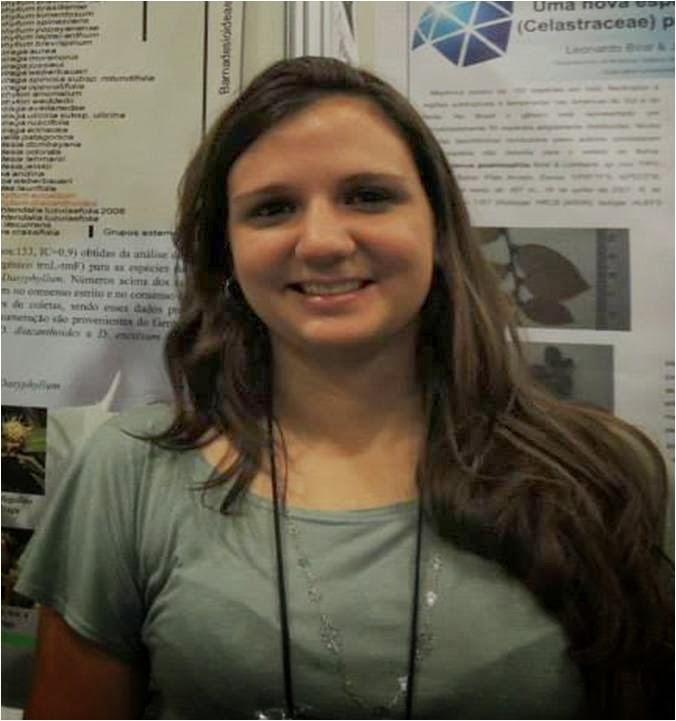
Como uma das funções deste blog é mostrar o que fazermos no nosso Laboratório, é bom contar que a  aluna de pós-graduação em Biologia Comparada Paola  de Lima Ferreira recebeu menção honrosa pelo seu painel durante o encontro deste ano. O painel da aluna Paola mostrou os primeiros resultados de um estudo filogenético do gênero neotropical Dasyphyllum, da família Asteraceae (a família das margaridas e dos girassóis) utilizando dados moleculares. O estudo conta com a colaboraçao da Dra. Mariana Saavedra, da Universidade Federal do Rio de Janeiro.
Parabéns pela conquista, Paola!

As one of the functions of this blog is to show what we do in our lab, it is a pleasure to inform that our graduate student in Comparative Biology Paola de Lima Ferreira has received an honorable mention for her poster in this year's Meeting. Paola´s poster showed the first results of a phylogenetic analysis of the Neotropical genus Dasyphyllum (family Asteraceae, the same of of daisies and sunflowers) using molecular data. This study  counts with the collaboration of Dr. Mariana Saavedra, from Federal University of Rio de Janeiro, Brazil.

Congratulations on your achievement, Paola!


Paola 

Paola´s poster